
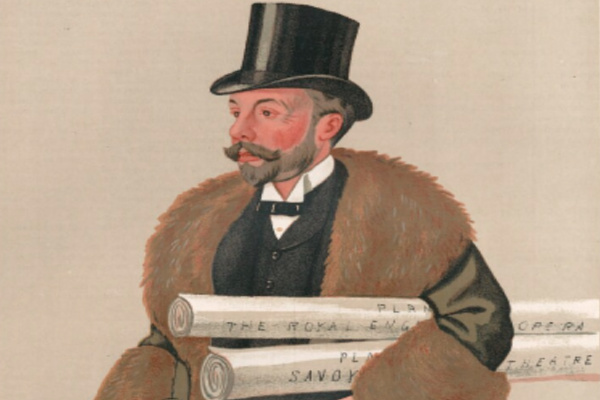
DEAD FAMOUS LONDONERS: RICHARD D’OYLY CARTE
Most people think the Savoy Hotel was built by a hotelier. It wasn’t. Richard D’Oyly Carte was a theatre impresario who needed a place for his opera-going audience to sleep. That distinction matters — because it explains everything about the man, his money, and the monument he left in central London.
D’Oyly Carte died in 1901, but his DNA is all over London’s West End. If you’ve ever seen a Gilbert and Sullivan operetta, stayed at the Savoy, or eaten at Simpson’s-in-the-Strand, you’ve touched his world. Here’s what you actually need to know about him, where to find his ghost, and why his story is weirder than you think.
The One Idea That Made Him Rich
Richard D’Oyly Carte didn’t invent operetta. He didn’t write a single note of music. What he did was spot a gap in the market and fill it with ruthless precision.
In the 1870s, London theatre was a mess. Cheap melodrama dominated. The audiences were rowdy. The venues smelled. D’Oyly Carte, a young agent and promoter, saw that there was a middle-class audience desperate for something smarter — witty, tuneful, and respectable enough to bring your wife to.
He found his vehicle in two men: W.S. Gilbert, a prickly barrister-turned-playwright, and Arthur Sullivan, a serious composer stuck writing hymns. D’Oyly Carte locked them into a partnership and built the D’Oyly Carte Opera Company to perform their work exclusively.
The result? H.M.S. Pinafore (1878), The Pirates of Penzance (1879), and The Mikado (1885) became the biggest theatrical hits of the Victorian era. They made Gilbert, Sullivan, and D’Oyly Carte rich beyond imagination.
The 43% Deal That Changed Theatre
D’Oyly Carte took a 43% cut of gross box office receipts. That’s a brutal number by modern standards. He justified it by taking all the financial risk — and he was right. When Pinafore flopped in its first run, D’Oyly Carte lost everything. He bounced back by licensing the show to American companies, making a fortune on the back end.
Lesson: D’Oyly Carte was not a patron of the arts. He was a businessman who treated theatre like a commodity. The art happened because the business worked.
Why the Savoy Hotel Exists (It’s Not About Luxury)
The Savoy Hotel opened in 1889. It was the first hotel in Britain with electric lights, electric lifts, and en-suite bathrooms. It was also the first hotel purpose-built for theatre audiences.
D’Oyly Carte built the Savoy Theatre in 1881 to stage Gilbert and Sullivan’s Patience. It was the first public building in the world lit entirely by electricity. Problem: the theatre sat 1,200 people. After a three-hour operetta, those 1,200 people needed somewhere to eat, drink, and sleep. London had no hotel that could handle that crowd at the right price point.
So D’Oyly Carte built one. He hired César Ritz to manage it and Auguste Escoffier to run the kitchen. The Savoy became the benchmark for luxury hotels globally.
What You Can Still See Today
The Savoy Hotel still stands on the Strand. You can walk in without staying there. The Thames Foyer serves afternoon tea under a glass dome. The American Bar is one of the best cocktail bars in London. Both are direct descendants of D’Oyly Carte’s original vision: treat the customer like royalty, charge accordingly.
Simpson’s-in-the-Strand, which D’Oyly Carte also owned, still serves its famous roast beef from a silver trolley. It’s expensive, but it’s the real thing.
The Grave Nobody Visits
Richard D’Oyly Carte is buried in St. Mary’s Churchyard, Golders Green. It’s not a tourist spot. The church is small, the graveyard is quiet, and the grave is a simple stone cross. No crowds. No guided tours.
Compare that to his contemporaries. Karl Marx’s grave in Highgate Cemetery gets busloads. D’Oyly Carte’s grave gets maybe a dozen people a year, most of them Gilbert and Sullivan obsessives.
That feels wrong. This man built the infrastructure of London’s theatre district. The Savoy Theatre, the Savoy Hotel, the D’Oyly Carte Opera Company — they’re all still running. His influence is everywhere. His grave is nowhere.
How to Find It
Golders Green is Zone 3 on the Northern Line. From the tube station, it’s a 10-minute walk northwest along Golders Green Road. St. Mary’s Churchyard is behind the church. The grave is near the eastern wall. Takes 15 minutes total. Do it on a weekday morning when it’s quiet.
Three Common Mistakes When Visiting His Sites
Tourists make the same errors over and over. Here’s what to avoid.
Mistake 1: Assuming the Savoy Theatre Is the Original
The current Savoy Theatre is a rebuild. The original burned down in 1990. The interior you see today — the art deco gold leaf, the red velvet, the chandeliers — is a 1993 reconstruction. It’s faithful to the original, but it’s not the same room where The Mikado premiered.
Go anyway. The acoustics are excellent and the guided tour (book ahead, £15) explains exactly what was lost and what was saved.
Mistake 2: Thinking the Savoy Hotel Is Just for Rich People
You can have a drink at the American Bar without spending £500 on a room. A cocktail costs £20-25. That’s expensive for London, but it’s not insane. You get the same furniture, the same service, the same view of the Thames that Edward VII enjoyed. Just order a Hanky Panky — the cocktail invented at the Savoy by bartender Ada Coleman in 1903.
Mistake 3: Ignoring the D’Oyly Carte Opera Company
The company went bankrupt in 1982. But it was revived in 1988 and still performs. Check their schedule at the D’Oyly Carte Opera Company website. They tour the UK regularly. Seeing a Gilbert and Sullivan operetta performed by the company named after the man who created the genre is the closest you’ll get to time travel.
When NOT to Visit These Places
This section saves you money and disappointment.
Don’t visit the Savoy Hotel in December. The Christmas afternoon tea is £95 per person, the lobby is packed with Instagram tourists, and the staff are stretched. Go in February instead. Same tea, half the crowd, no surcharge.
Don’t visit the Savoy Theatre for a musical. The theatre is designed for opera and spoken-word drama. Musicals with loud amplification overwhelm the acoustic. Go see a play or an operetta.
Don’t visit St. Mary’s Churchyard in the rain. The ground gets muddy and the grave is hard to find. Check the weather. A dry, overcast Tuesday morning is ideal.
| Site | Best Time to Visit | Cost | Time Needed |
|---|---|---|---|
| Savoy Hotel (American Bar) | Weekday, 3-5pm | £20-25 per cocktail | 1 hour |
| Savoy Theatre | Show night, 7pm | £25-150 per ticket | 3 hours |
| Simpson’s-in-the-Strand | Weekday lunch, 12pm | £45-60 per person | 1.5 hours |
| St. Mary’s Churchyard | Weekday morning | Free | 15-30 minutes |
The Real Legacy: Not the Hotel, Not the Theatre
Here’s the thing nobody tells you. Richard D’Oyly Carte’s most important contribution wasn’t the Savoy Hotel or even the Savoy Theatre. It was the D’Oyly Carte Opera Company — the first theatrical company in history to operate on a fully professional, permanent, touring basis.
Before D’Oyly Carte, theatre companies were ad-hoc. Actors were hired per show. Rehearsals were brief. Standards were low. D’Oyly Carte created a permanent ensemble with salaried performers, year-round contracts, and a dedicated rehearsal period for every production. That model became the template for every major theatre company in the Western world.
The Royal Shakespeare Company. The National Theatre. Broadway’s big musicals. They all trace their organizational DNA back to D’Oyly Carte.
He also pioneered the concept of the long run. Instead of a show running for a few weeks and then closing, D’Oyly Carte kept The Mikado running for two years. That changed the economics of theatre forever. A hit show could now generate profit for years, not weeks.
What That Means for You
When you sit in any theatre in London’s West End, you’re sitting in a building that exists because Richard D’Oyly Carte proved theatre could be a sustainable business. The Savoy is just the most visible monument. The real monument is the entire theatre district.
One Last Thing: The Man Was a Control Freak
D’Oyly Carte micromanaged everything. He personally approved every costume, every light cue, every menu item at the Savoy. He fired César Ritz in 1897 over a dispute about wine pricing. He fell out with Gilbert and Sullivan multiple times, each time more bitter than the last.
That controlling personality is why his legacy survived. He didn’t trust anyone else to run his empire. So he ran it himself, obsessively, until the day he died. The result is a set of institutions that have lasted 140 years because they were built to a single man’s uncompromising standard.
You can argue with his methods. You can’t argue with the results.
Next time you walk past the Savoy Hotel, stop for a second. Look at the electric lights in the lobby. Think about the fact that they were installed in 1889, when most of London still used gas. Then walk into the American Bar, order a Hanky Panky, and toast the dead impresario who made it all possible.

Leave a Reply