
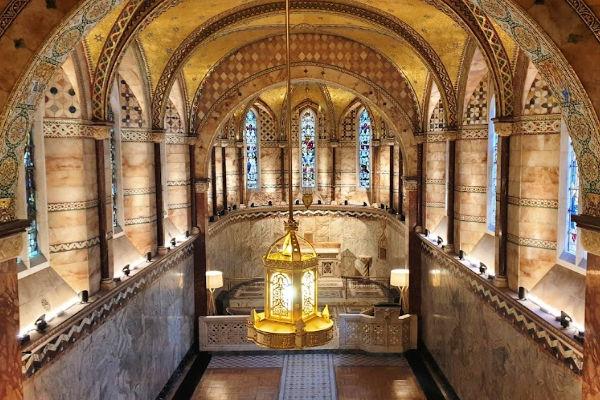
FITZROVIA CHAPEL | BYZTANTINE BLING IN LONDON
Most people walk past 2 Pearson Square without a second glance. It’s a glassy office block near Oxford Street, home to dentists and dermatologists. But inside its ground floor sits one of London’s most ridiculous interiors — a tiny chapel covered in gold mosaic, Italian marble, and enough Byzantine bling to make Istanbul jealous.
The Fitzrovia Chapel is what happens when a Victorian architect gets unlimited money and a very specific brief: build a hospital chapel that looks like a 6th-century Ravenna basilica. It’s free to enter, open most weekdays, and almost nobody knows it exists.
What Exactly Is the Fitzrovia Chapel?
It’s the last surviving piece of the old Middlesex Hospital, demolished in 2008 to make way for luxury flats and offices. The chapel was saved after a public campaign — and thank god for that.
John Loughborough Pearson designed it in 1892. His son Frank finished it in 1929. The Pearsons were specialists in Gothic revival churches, but here they went full Byzantine. The result is a small room — 20 metres long, 8 metres wide — that packs more decorative punch than cathedrals ten times its size.
Why Byzantine?
Byzantine architecture peaked in the Eastern Roman Empire around 500-600 AD. Think Hagia Sophia in Istanbul, San Vitale in Ravenna. Key features: central domes, round arches, lots of gold mosaic, and a sense that the building is a jewel box rather than a hall.
The Victorians revived this style for places that needed to feel sacred but intimate. Hospitals were a perfect fit. The Middlesex Hospital chapel was designed as a quiet space for patients, staff, and families — a small sanctuary inside a massive institution.
What Makes It Special?
Three things separate it from every other London chapel:
- The gold mosaic ceiling. The entire vault is covered in gold leaf tesserae — tiny glass tiles set at slightly different angles so they catch light differently throughout the day. It glows.
- The marble work. 14 different types of Italian marble line the walls. Carrara, Siena, Verde Antico — each column and panel is a different stone.
- The sheer contrast. You walk in from a sterile office lobby and suddenly you’re in a space that hasn’t changed since 1929. The smell alone — old stone, beeswax, silence — is worth the trip.
Verdict: If you only see one hidden chapel in London, make it this one. It’s smaller than St John’s Chapel in the Tower of London, but the interior is more intact and far more accessible.
How to Visit the Fitzrovia Chapel in 2026
Here’s the catch: it’s not a functioning church. It’s a heritage space run by a trust. So opening hours are weird, and you need to plan.
Opening Hours and Entry
Open Monday to Friday, 10:00 to 16:00. Closed weekends and bank holidays. Entry is free — no ticket, no booking, just walk in.
But check their website before you go. The chapel is sometimes closed for private events — weddings, photoshoots, corporate things. If a film crew is in there, you’re out of luck.
The address is 2 Pearson Square, London W1W 7BZ. Entrance is through the office lobby. There’s a small sign outside, but it’s easy to miss. Look for the glass doors next to the Pret a Manger.
Getting There
Nearest tube: Great Portland Street (5 min walk), Oxford Circus (10 min), Warren Street (8 min).
If you’re coming from central London, walk up Cleveland Street past the BT Tower. The chapel is tucked behind the new Fitzroy Place development.
Best time to visit: Mid-morning on a Tuesday or Wednesday. Fewer people, better light through the alabaster windows. The gold mosaic really comes alive between 11:00 and 13:00.
How Long to Spend
30 minutes is plenty. You can see everything in 15 if you’re rushing, but sit on the wooden benches for a few minutes. The silence is remarkable for a building in Zone 1.
What to Look For Inside
Most visitors walk in, look up at the ceiling, take a photo, and leave. Don’t do that. There are specific details worth hunting for.
| Feature | What to Look For | Why It Matters |
|---|---|---|
| Apse mosaic | Christ in Majesty, surrounded by angels and saints | Designed by Frank Pearson, executed by James Powell & Sons — the same firm that did stained glass for Westminster Abbey |
| Alabaster windows | Thin slabs of translucent alabaster instead of stained glass | Lets in warm, diffused light without coloured imagery. Rare in the UK — more common in Italian churches |
| Cosmati pavement | Intricate geometric floor pattern near the altar | Same technique used in Westminster Abbey’s sanctuary. Tiny pieces of coloured marble set in a repeating design |
| Marble columns | 14 different varieties, each with a label on the base | Victorian geologists loved this stuff. It’s basically a textbook of decorative stone |
| Dome interior | Gold tesserae with a central Chi-Rho monogram | Each tile is about 1cm square. There are roughly 80,000 of them |
Don’t miss: The small brass plaque on the left wall commemorating nurses who died in WWI. It’s easy to overlook but sobering in this quiet space.
How the Fitzrovia Chapel Compares to Other London Hidden Chapels
London has several small historic chapels. Most are older. None have this level of decorative intensity.
St John’s Chapel, Tower of London — Norman, built 1080. Older by 800 years. But it’s inside a tourist attraction (£34.80 entry), and the interior is mostly bare stone. Impressive for its age, not for its bling.
Chapel of St Mary Undercroft, Houses of Parliament — Gothic, 13th century. Beautiful fan-vaulted ceiling. But you can only visit on a parliamentary tour, and you need to book months ahead.
Wren’s City churches — St Stephen Walbrook, St Mary-le-Bow. Fine interiors, but they’re mostly white plaster and gold leaf accents. The Fitzrovia Chapel is mosaic-covered from floor to ceiling.
Brompton Oratory — Baroque, massive, impressive. But it’s an active church with services and tourists. The Fitzrovia Chapel is quieter and more intimate.
Verdict: For pure visual overload in a small space, the Fitzrovia Chapel wins. It’s the closest thing to a Byzantine church you’ll find in London without a plane ticket to Ravenna.
When NOT to Visit the Fitzrovia Chapel
This chapel has genuine limitations. Knowing them saves you a wasted trip.
Weekends and Bank Holidays
Closed. No exceptions. If you’re in London Saturday-Sunday, pick something else. The chapel is only open Monday-Friday.
Private Events
About 20% of weekdays the chapel is closed for weddings, photography, or corporate hire. Always check the chapel’s website before travelling. There’s no backup plan — the office lobby is just a lobby.
Claustrophobia
The chapel is genuinely small. 20 metres long, 8 metres wide. If crowded spaces bother you, go early. By 14:00 it can feel tight, especially if a tour group arrives.
Accessibility
Flat entrance from street level. No steps inside. Wheelchair accessible. But the benches are fixed wooden pews — not comfortable for long sits.
Photography Restrictions
No flash. No tripods without permission. Phone photos are fine. If you want professional shots, you need to book a photoshoot slot (costs around £150/hour).
Honest take: If you’re short on time in London, skip this and go to the British Museum or St Paul’s. The Fitzrovia Chapel is a 30-minute detour for people who’ve already seen the big stuff. It’s not a replacement for a major attraction.
What Tourists Usually Get Wrong About This Chapel
Three common mistakes. Avoid them.
Mistake 1: Confusing It with St George’s Chapel or the Guards Chapel
St George’s Chapel is in Windsor Castle. The Guards Chapel is near Buckingham Palace. The Fitzrovia Chapel is in an office block. Different buildings. Different histories. If you tell a taxi driver “take me to the chapel in Fitzrovia”, they’ll look at you blankly. Say “2 Pearson Square, near Great Portland Street station”.
Mistake 2: Expecting a Church Service
There are no regular services. The chapel is deconsecrated. It’s a heritage space, not a place of worship. If you want to attend mass, go to the nearby St Patrick’s Church in Soho Square (10 minutes walk).
Mistake 3: Arriving at 15:45
They close at 16:00 sharp. Security will start ushering you out at 15:50. Give yourself at least 20 minutes inside. Arriving late means a rushed visit and annoyed staff.
Pro tip: Combine this with a walk through Fitzroy Square (5 minutes north) and lunch at one of the Charlotte Street restaurants. That’s a solid Fitzrovia afternoon.
Why This Chapel Matters Beyond Its Beauty
The Fitzrovia Chapel is a relic of a specific moment in London history. The Middlesex Hospital was founded in 1745 and grew into one of London’s major teaching hospitals. The chapel was built at the peak of Victorian hospital philanthropy — when wealthy donors funded chapels, wards, and nursing schools as a moral duty.
The hospital closed in 2008. The site was redeveloped into luxury apartments starting at £2 million. The chapel survived because local campaigners — including patients, nurses, and architectural historians — fought for it. It’s now a Grade I listed building, managed by a charitable trust.
What you’re seeing is a fragment of a lost world. Victorian hospitals were cities within cities. They had chapels, laundries, kitchens, mortuaries, gardens. Almost all of that is gone. The chapel is the last physical reminder of what the Middlesex Hospital was.
And it’s free. No gift shop. No donation box (though there is a QR code for the trust). Just a quiet room full of gold and marble, sitting in the middle of a 21st-century office block. That’s worth 30 minutes of your time.

Leave a Reply